
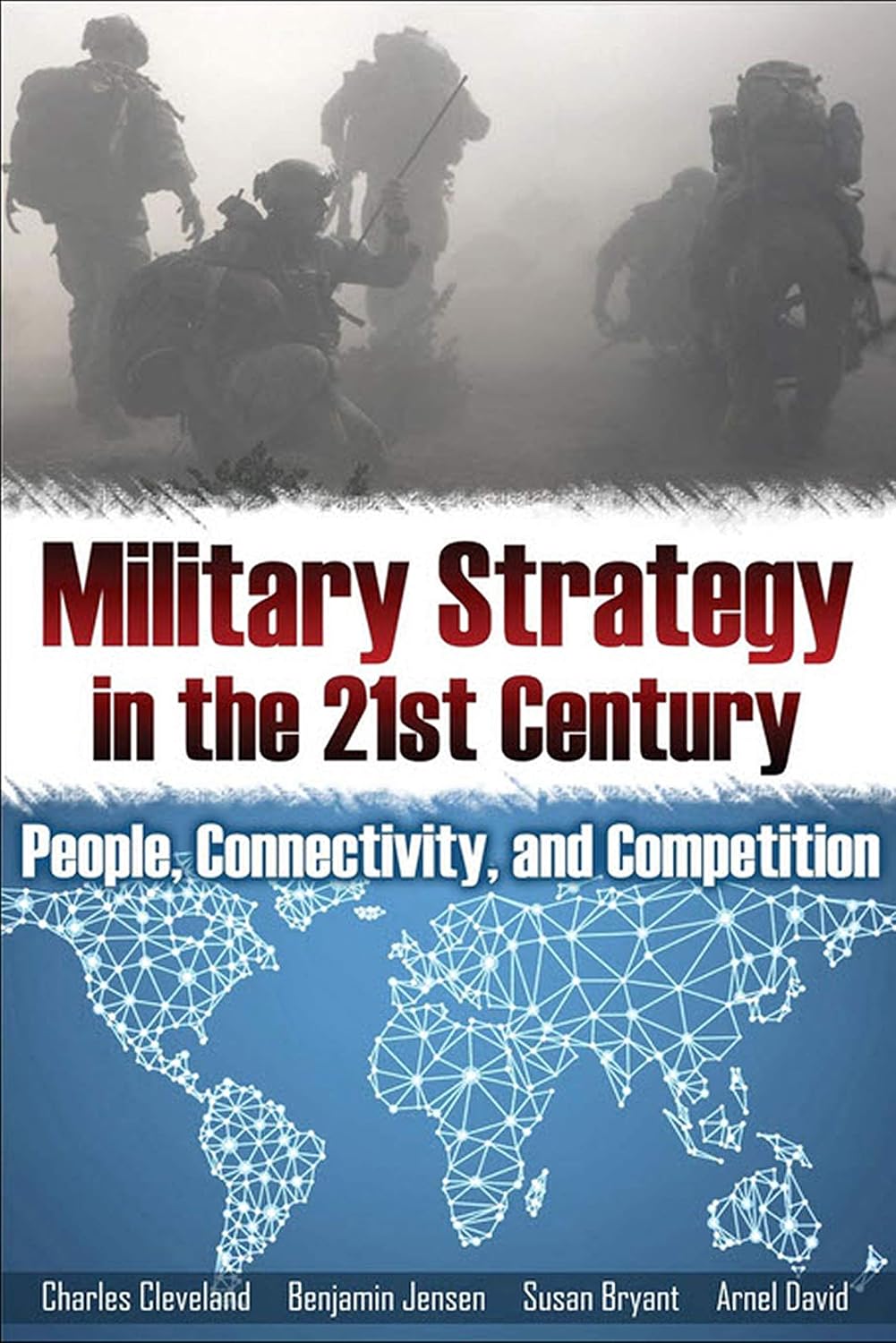
Military Strategy in the 21st Century: People, Connectivity, and Competition (Rapid Communications in Conflict & Security Series)
Product details
| Management number | 231938728 | Release Date | 2026/06/18 | List Price | US$10.33 | Model Number | 231938728 | ||
|---|---|---|---|---|---|---|---|---|---|
| Category | |||||||||
The character of not only war but also strategic competition appears to be changing. Failing to adapt will result in further losses of blood and treasure as well as prestige and influence. Power withers when it proves frail. This book by Charles Cleveland, Benjamin Jensen, Susan Bryant, and Arnel David calls for the rethinking of how the U.S. national security community approaches population-centric warfare and strategic competition in the 21st century. Strategic advantage in the 21st century will emerge from mapping human geography in a connected world, leveraging key relationships, and applying a mix of unconventional and conventional methods that put adversaries on the horns of a dilemma. The authors outline a new approach to thinking about military art rooted in increasing connectivity and defining a new domain of competition, the human domain. In the 21st century, strategic advantage will emerge from how we engage with and understand people and access political, economic, and social networks to achieve a position of relative advantage that complements American military strength. These interactions are not reducible to the physical confines of the land domain, which tend to focus on geography and terrain features. They represent a web of networks that define power and interests in a connected world. The state that bests understands local contexts and builds a network around relationships harnessing local capacity is more likely to win the 21st century struggle for the flanks. Military power exercised through joint combined arms is no longer sufficient to compel adversaries or control populations. Just as conventional forces like those of the United States increased their ability for precision strike and lethal fires, competitors opted to shift strategic competition away from direct confrontations to an indirect clash of wills. The weak undermine the strong through mobilizing local populations—often through predation and manipulating grievances—to carry out insurgent attacks, terrorism, civilian massacres, propaganda campaigns and cyber-attacks. The site of this clash of wills, occurring predominantly in civilian populations and their relational networks as opposed to battlefields of old, reduces the U.S. military’s comparative advantage in combined arms maneuver. As a result, military art is practiced increasingly in a human domain. Military Strategy in the 21st Century makes the case that to be successful in these 21st century struggles, the military profession must recognize and organize for its role in these indirect conflicts and develop appropriate concepts that account for the need to gain a position of advantage in the human domain. Leading military powers like the United States must find a way to maneuver in an interconnected world of competing influence networks. America’s military needs to be part of a global security network optimized for 21st century influence campaigns backed by military force as opposed to fighting 20th century military campaigns loosely backed by information operations. This is an important volume for the military professional, academics who study political violence and security, and general reader interested in the changing character of strategy and conflict. The book would be useful in a range of classroom settings including Professional Military Education (PME), university classes on contemporary military practice and strategy, and graduate classes in security studies and international relations. Read more
| ASIN | B07G7MZR5B |
|---|---|
| XRay | Not Enabled |
| Language | English |
| File size | 1.4 MB |
| Page Flip | Enabled |
| Publisher | Cambria Press |
| Word Wise | Enabled |
| Print length | 312 pages |
| Accessibility | Learn more |
| Screen Reader | Supported |
| Part of series | Rapid Communications in Conflict & Security Series |
| Publication date | August 6, 2018 |
| Enhanced typesetting | Enabled |
Bestseller ranking
National & International Security





Customers who viewed this product also viewed
General


Correction of product information
If you notice any omissions or errors in the product information on this page, please use the correction request form below.
Correction Request Form